Sergeant Matthew Briggs had been out of the Army for seven years when he finally admitted he was not okay. The 41-year-old former infantryman in Colorado Springs had tried the VA twice. The first appointment was canceled after a six-week wait. The second came through, but the assigned counselor had never deployed and asked questions that made Matthew feel like a case file. He stopped going. His wife, a nurse named Jenna, watched him stop sleeping and start drinking again. One Sunday evening she pulled up Cohen Veterans Network on her laptop and read aloud the line about therapy at no cost to post-9/11 veterans and their families. Matthew flinched at the word “free” but agreed to call. The intake clinician at the Steven A. Cohen Military Family Clinic asked him in the first ten minutes whether he wanted Cognitive Processing Therapy or Prolonged Exposure, and explained both. Matthew had never heard a clinician speak that language. Six weeks later, he was sleeping through the night for the first time since 2019. The search for a veterans therapist near me outside the VA is rarely simple, but the options have grown.

When VA care is not enough or not accessible
The Department of Veterans Affairs runs the largest mental health system in the country, and for many veterans it is the right home. For others, VA care does not fit. Rural veterans may live two hours from the nearest VA medical center. Veterans with Military Sexual Trauma, often called MST, may avoid the VA entirely if their assault occurred at a VA-connected facility or unit. Wait times for evidence-based PTSD therapy at busy VA centers can exceed three months. Veterans with Other Than Honorable discharges may be ineligible for some services. National Guard and Reserve veterans without 24 months of active-duty service can fall through cracks. Each of these gaps creates demand for civilian options, and a search for a veterans therapist near me outside the VA system reflects a real and growing need.
The good news is that the civilian network for veteran-specific care has expanded substantially since 2017. Several pathways now offer evidence-based PTSD treatment at low or no cost, and many use the same protocols developed and validated at VA research centers. The challenge is knowing the names and how to access them.
Cohen Veterans Network clinics nationwide
The Cohen Veterans Network, founded by hedge fund manager Steven A. Cohen in 2016, runs more than 20 clinics across the United States and offers therapy at no cost to post-9/11 veterans, regardless of discharge status, and to their family members. The network treats PTSD, depression, anxiety, substance use, marital problems, and child behavioral issues tied to military life. Clinicians are civilian-trained but receive military cultural competence training and supervision. Many are licensed marriage and family therapists, social workers, or psychologists with extensive trauma background. Telehealth is available across state lines through CVN Telehealth.
Cohen clinics typically deliver Cognitive Processing Therapy, Prolonged Exposure, EMDR, and family-based interventions. Sessions are funded through the network’s philanthropic model rather than insurance billing, which removes the documentation friction that drives some veterans away from the VA. Eligibility includes anyone who served on active duty after September 11, 2001, including Guard and Reserve members.
Give an Hour and pre-9/11 eligibility
Give an Hour, founded by psychologist Dr. Barbara Van Dahlen in 2005, recruits licensed mental health professionals who donate one hour per week to veterans, service members, and their families. The model is broader than Cohen’s eligibility window. Vietnam veterans, Gulf War veterans, and Cold War-era service members can access Give an Hour providers regardless of discharge status. The directory is searchable by state and clinical focus.
The trade-off is that Give an Hour clinicians vary in trauma specialization. Screen carefully. Ask whether the provider is trained in CPT or PE specifically, how many veterans they have treated in the past year, and whether they understand military culture beyond a weekend training. The strongest matches often come through Give an Hour clinicians who served themselves or who work alongside the VA’s Community Care Network.

Finding CPT and PE-trained providers
Cognitive Processing Therapy and Prolonged Exposure are the two PTSD treatments with the strongest research base. Both were developed and refined in part through VA-funded studies. Both are time-limited, typically 8 to 15 sessions, and both have been shown to substantially reduce PTSD symptoms in roughly 60 to 80 percent of veterans who complete treatment. Generic talk therapy is not the same. If a clinician offers only weekly supportive sessions for combat trauma, they are not delivering an evidence-based PTSD treatment, and the research literature is clear that outcomes lag.
Several directories help patients find clinicians trained in the protocols. The PTSD Consultation Program, run through the National Center for PTSD at ptsd.va.gov, offers a clinician locator and consultation line for both providers and patients. The American Psychological Association’s Society of Clinical Psychology lists evidence-based providers. State psychological associations sometimes maintain trauma-specialty rosters. For background on residential PTSD options when outpatient is not enough, see our companion piece on trauma residential PTSD treatment.
Vet Centers: community-based VA care that does not feel like the VA
Vet Centers are technically part of VA’s Readjustment Counseling Service, but they operate as separate community storefronts and do not require VA enrollment. There are roughly 300 Vet Centers and dozens of mobile units nationwide. They serve combat veterans of any era, MST survivors, and veterans who served in hostile or hazardous environments. Family members of eligible veterans qualify for limited services. Vet Centers offer individual, group, marriage, and bereavement counseling at no cost. Many are staffed by combat veterans themselves, which removes a barrier some veterans hit at hospital-based clinics.
Vet Centers do not file claims to VA benefits. They keep separate records that are confidential by federal statute. For a veteran who fears that mental health treatment could affect a security clearance, a benefits claim, or an OTH reconsideration, the Vet Center model is often a better fit than the medical center. The locator is published at va.gov under Vet Centers.
Community Care Network referrals
The VA’s Community Care Network, expanded under the MISSION Act of 2018, allows VA-enrolled veterans to receive care from civilian providers when VA care is unavailable, too distant, or clinically inappropriate for the veteran’s needs. Eligibility criteria include a 30-minute drive standard for primary care, a 60-minute standard for specialty care, and a 20-day wait standard for primary and mental health care. If your local VA cannot meet those standards, you may qualify for a community care referral. The clinician who treats you is paid by the VA and reports back through standard channels.
Community care referrals are most useful for veterans who want VA-coordinated care but cannot access it locally. The trade-off is that the documentation flows back through the VA, so veterans who specifically want care outside the VA medical record may prefer Cohen, Give an Hour, or fee-for-service civilian options. We discuss the broader VA mental health system in our overview of VA mental health care.
MST specialists and trauma-informed care
Military Sexual Trauma affects roughly one in three women veterans and one in fifty men veterans, according to VA screening data. The clinical picture is often complex. Many MST survivors avoid the VA, particularly if their assault occurred in a VA-adjacent setting or if the perpetrator remains in service. Civilian MST specialists are essential, and several pathways connect survivors to them. Cohen Veterans Network clinics treat MST. Vet Centers are statutorily authorized to provide MST counseling at no cost regardless of VA enrollment status. The Service Women’s Action Network maintains a referral resource. The VA also offers MST-specific care that is free regardless of discharge status, and that information lives at va.gov.
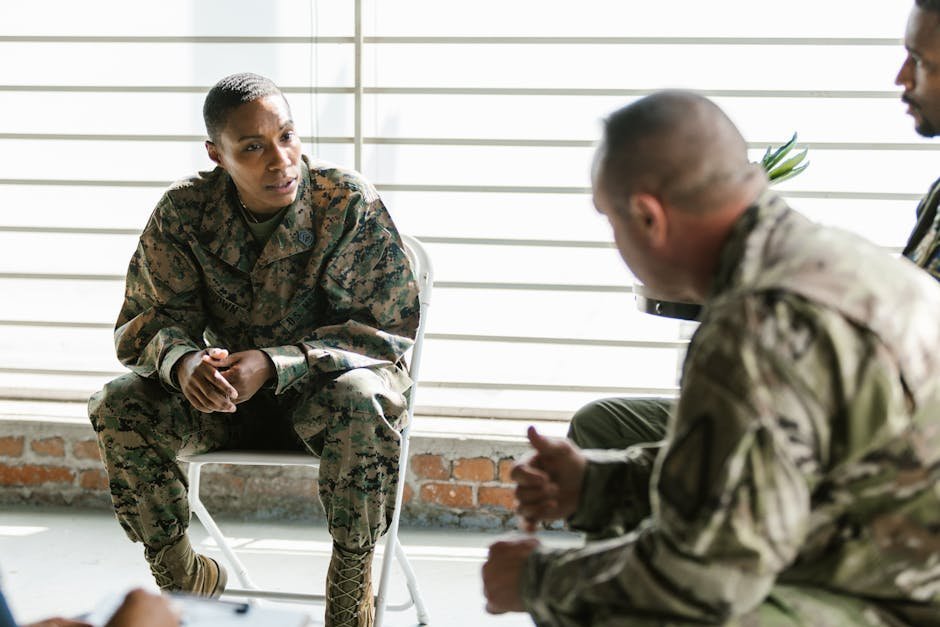
Trauma-informed care principles apply across all of these settings. A clinician should ask about your preferences for room layout, gender of provider, and pacing. They should not push exposure work before stabilization. They should be transparent about documentation. If a screening call leaves you feeling rushed or judged, that is your data point.
Family therapy and TBI considerations
Combat trauma rarely lives in one person. Spouses, children, and parents carry the secondary effects in ways that show up as marital strain, parenting friction, and family avoidance. Many of the strongest civilian veteran clinics offer family-based interventions alongside individual PTSD treatment.
- Cohen Veterans Network includes family therapy and child sessions in standard care.
- Give an Hour providers commonly include marriage and family therapists.
- Vet Centers offer marriage and bereavement counseling.
- Strong Bonds is the Army’s chaplain-run marriage retreat program, available to active duty and Reserve.
- Operation We Are Here maintains a curated list of veteran family resources by state.
Traumatic Brain Injury complicates the picture. Roughly 20 percent of post-9/11 combat veterans screen positive for blast-related TBI. Symptoms overlap heavily with PTSD, including memory issues, irritability, and sleep disruption. The Defense and Veterans Brain Injury Center, now operating under the Traumatic Brain Injury Center of Excellence, runs research and clinical programs across military and civilian sites. A skilled veteran-focused clinician will screen for TBI and refer to neuropsychological evaluation when symptoms suggest more than psychological injury. We cover this in depth in our piece on veterans trauma treatment.
Frequently asked questions
Will civilian therapy affect my disability claim?
Civilian records can be used to support a claim if you submit them. They do not automatically flow to VA. Some veterans find that civilian documentation strengthens a case because the clinician is independent of VA. Discuss documentation with your attorney or VSO if you have an open claim.
Can I see a Cohen clinic if I have an Other Than Honorable discharge?
Yes. Cohen Veterans Network serves post-9/11 veterans regardless of discharge status. This is one of the most important differences from many VA-only programs.
How do I know if a therapist is actually CPT or PE trained?
Ask directly. A trained provider will name the developer (Patricia Resick for CPT, Edna Foa for PE), describe the protocol structure, and tell you how many full protocols they have completed with patients in the past year. Vague answers are a signal.
Is telehealth as effective as in-person trauma therapy?
Multiple VA-led trials show comparable outcomes for CPT delivered by telehealth and in person, especially for veterans who would otherwise not access care. PE telehealth has more mixed evidence and is often best when paired with strong stabilization.
What if I am in crisis tonight?
Call or text 988 and press 1 to reach the Veterans Crisis Line. Counselors are veterans or family members of veterans and can connect you to immediate support.
The bottom line
The search for a veterans therapist near me outside the VA is no longer a dead end. Cohen Veterans Network, Give an Hour, Vet Centers, Community Care Network referrals, and MST specialists together create a meaningful civilian-side option for veterans whose VA experience has not worked or whose situation falls outside VA eligibility. Insist on evidence-based protocols. Screen for cultural competence. Lean on the family-inclusive options when the trauma has affected more than just you. Recovery from combat trauma is one of the best-studied clinical outcomes in modern psychology, and the right clinician can help you reach it. The path is real. So is the work.
If you or a veteran you love is in crisis, call or text 988 and press 1 to reach the Veterans Crisis Line, available 24 hours a day at no cost. Confidential chat is available at VeteransCrisisLine.net.
This article is for educational purposes and does not replace medical or psychological advice from a licensed clinician. If you are struggling, please reach out to a qualified mental health professional in your area.