
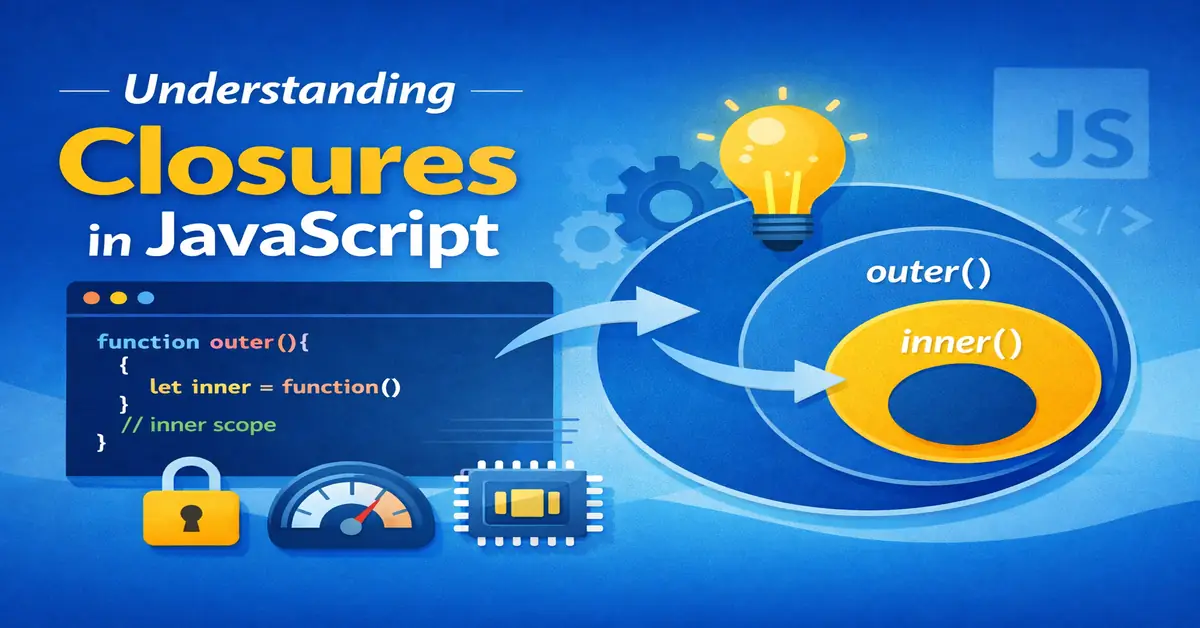
Closures are one of the most important and most misunderstood concepts in JavaScript. If you work with callbacks, event handlers, React hooks, or async code, you are already using closures—whether you realize it or not.
This article explains closures from the ground up, with real-world examples, performance notes, and common pitfalls.
Closure Definition (In Simple Terms)
A closure is created when a function remembers and accesses variables from its outer scope, even after the outer function has finished executing.
In JavaScript:
- Functions form closures automatically
- No special syntax is required
- Closures exist because of lexical scoping
Basic Closure Example
function outer() {
  let count = 0;

  function inner() {
    count++;
    return count;
  }

  return inner;
}

const counter = outer();

counter(); // 1
counter(); // 2
counter(); // 3
What’s Happening Internally?
outer()executes and returnsinnercountshould be destroyed afterouter()finishes- But
inner()closes overcount - JavaScript keeps
countalive in memory
This preserved scope is the closure.
Why Closures Exist in JavaScript
Closures exist because JavaScript uses lexical scoping, meaning:
- Scope is determined at write-time, not run-time
- Inner functions can access outer variables
This behavior enables:
- Data privacy
- State preservation
- Functional programming patterns
Real-World Use Cases of Closures
1. Data Encapsulation (Private Variables)
function createUser(name) {
  let isLoggedIn = false;

  return {
    login() {
      isLoggedIn = true;
    },
    status() {
      return isLoggedIn;
    }
  };
}

const user = createUser('Alex');
user.login();
user.status(); // true
No external code can directly access isLoggedIn.
2. Callbacks and Event Handlers
function attachHandler(buttonId) {
  const clickCount = 0;

  document.getElementById(buttonId)
    .addEventListener('click', function () {
      console.log(clickCount);
    });
}
The event handler keeps access to clickCount through closure.
3. setTimeout and Async Code
function delayedMessage(msg) {
  setTimeout(() => {
    console.log(msg);
  }, 1000);
}

delayedMessage('Hello');
Even after delayedMessage() finishes, msg remains accessible.
Closure vs Scope (Quick Comparison)
| Aspect | Scope | Closure |
|---|---|---|
| When defined | At function/block creation | At function execution |
| Purpose | Variable visibility | Preserve outer variables |
| Memory | Released after execution | Retained if referenced |
Common Closure Mistake (Loop Issue)
for (var i = 1; i <= 3; i++) {
  setTimeout(() => console.log(i), 1000);
}
Output: 4 4 4
Why This Happens
varis function-scoped- One shared
iis closed over - Loop finishes before
setTimeoutruns
Fix Using let
for (let i = 1; i <= 3; i++) {
  setTimeout(() => console.log(i), 1000);
}
let creates a new binding per iteration.
Memory Considerations with Closures
Closures can increase memory usage if misused.
Potential Issues
- Long-lived references
- Unreleased DOM elements
- Large objects kept alive unnecessarily
Best Practices
- Avoid closing over large objects
- Remove event listeners when not needed
- Nullify references when done
Closures in Modern JavaScript Frameworks
React
- Hooks rely heavily on closures
useEffectcaptures variables- Stale closure bugs are common
Node.js
- Closures maintain request state
- Used in middleware and callbacks
Closures are foundational—not optional knowledge.
Performance Comparison Table
| Approach | Memory Usage | Readability | Use Case |
|---|---|---|---|
| Global variables | High risk | Low | Avoid |
| Class-based state | Medium | Medium | Large systems |
| Closure-based state | Controlled | High | Functional patterns |
Summary
- Closures allow functions to remember outer variables
- They are created automatically in JavaScript
- Used in callbacks, async code, and frameworks
- Powerful but must be handled carefully
Understanding closures unlocks advanced JavaScript patterns.
Frequently Asked Questions (FAQ)
What is a closure in JavaScript?
A closure is a function that retains access to variables from its outer scope even after that scope has finished executing.
Are closures created manually?
No. Closures are created automatically whenever a function accesses outer variables.
Do closures cause memory leaks?
They can if references are kept unnecessarily. Proper cleanup prevents issues.
Are closures used in React?
Yes. Hooks like useEffect and useCallback depend on closures.