
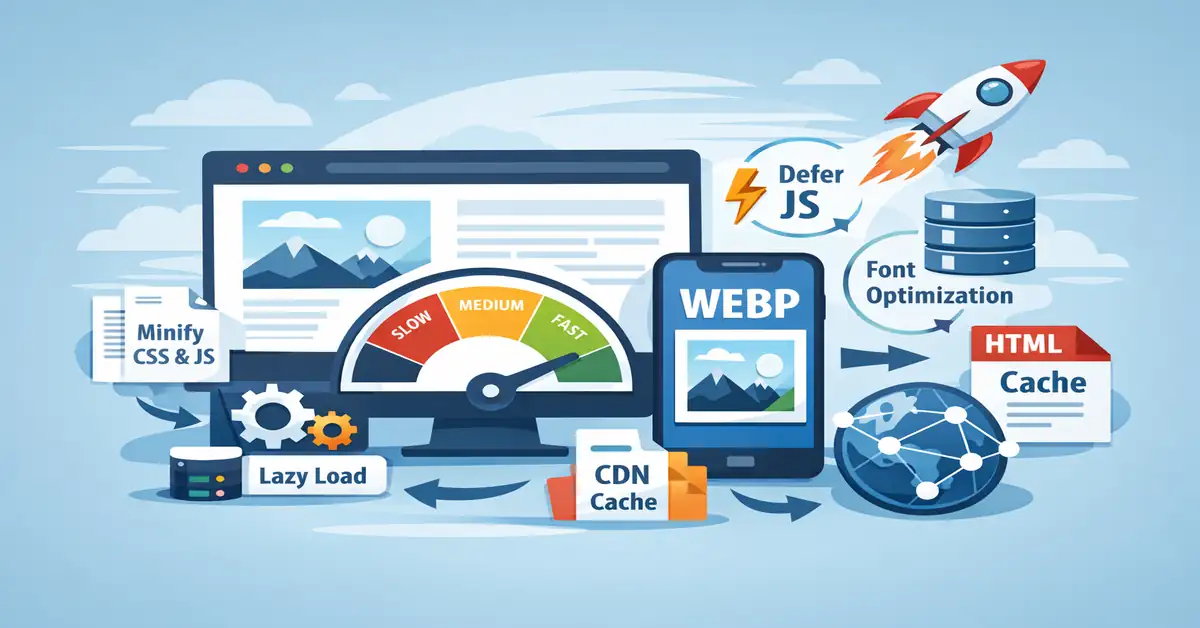
This guide is based on real production experience. No theory. Only changes that actually improve load time, Core Web Vitals, and crawl efficiency.
CSS Optimization
- Remove unused CSS from themes and plugins.
- Minify CSS files.
- Avoid loading full frameworks if only small utilities are used.
- Inline critical CSS for above‑the‑fold content.
- Combine CSS only when HTTP/2 benefits are not effective.
JavaScript Optimization
- Remove unused JavaScript files and inline scripts.
- Minify all JS.
- Use
deferfor non‑critical scripts. - Avoid
asyncfor dependent scripts. - Delay heavy scripts like ads, analytics, and trackers.
- Reduce JavaScript execution during initial page load.
- Replace heavy libraries with native JavaScript where possible.
jQuery Handling
- Preload jQuery only if it is required early.
- Remove jQuery completely if the site works without it.
- Avoid loading multiple versions of the same library.
Image Optimization
- Convert all images to WebP.
- Serve images in exact display size.
- Always define
widthandheightattributes. - Lazy‑load all below‑the‑fold images.
- Never lazy‑load the LCP image.
- Preload only the feature image when it is the LCP element.
Font Optimization
- Preload only critical fonts.
- Use
font-display: swap. - Remove unused font weights and styles.
- Avoid loading fonts globally if used on limited pages.
Lazy Loading Strategy
- Lazy‑load images, iframes, and embeds.
- Exclude hero section and above‑the‑fold elements.
- Prefer native lazy loading over JS‑based solutions.
Network Optimization
- Use
preconnectfor critical third‑party origins. - Use
dns-prefetchfor secondary domains. - Reduce external requests aggressively.
Caching Strategy
- Enable browser cache with long TTL for static assets.
- Use HTML cache for anonymous users.
- Enable object cache (Redis / Memcached).
- Enable PHP OPcache.
- Cache images, CSS, JS, and fonts at CDN level.
Static Cache Policy
- Use immutable caching for versioned assets.
- Separate cache rules for HTML and static files.
- Avoid automatic CDN cache purge on small updates.
Server & Backend Optimization
- Fix TTFB before frontend optimizations.
- Optimize database queries.
- Reduce unnecessary AJAX calls.
- Load menus and widgets asynchronously.
- Avoid heavy PHP logic on every request.
Content & DOM Optimization
- Reduce DOM size.
- Remove unnecessary wrappers and elements.
- Avoid layout‑breaking animations.
- Compress final HTML output.
- Remove unused widgets and third‑party embeds.
Script Control
- Delay scripts not required for first interaction.
- Remove globally loaded scripts used on single pages.
- Avoid CPU‑intensive JS during page load.
What Actually Improves Core Web Vitals
- LCP: Feature image optimization + render‑blocking removal
- INP: Reduced JS execution and delayed scripts
- CLS: Fixed dimensions, proper font handling