
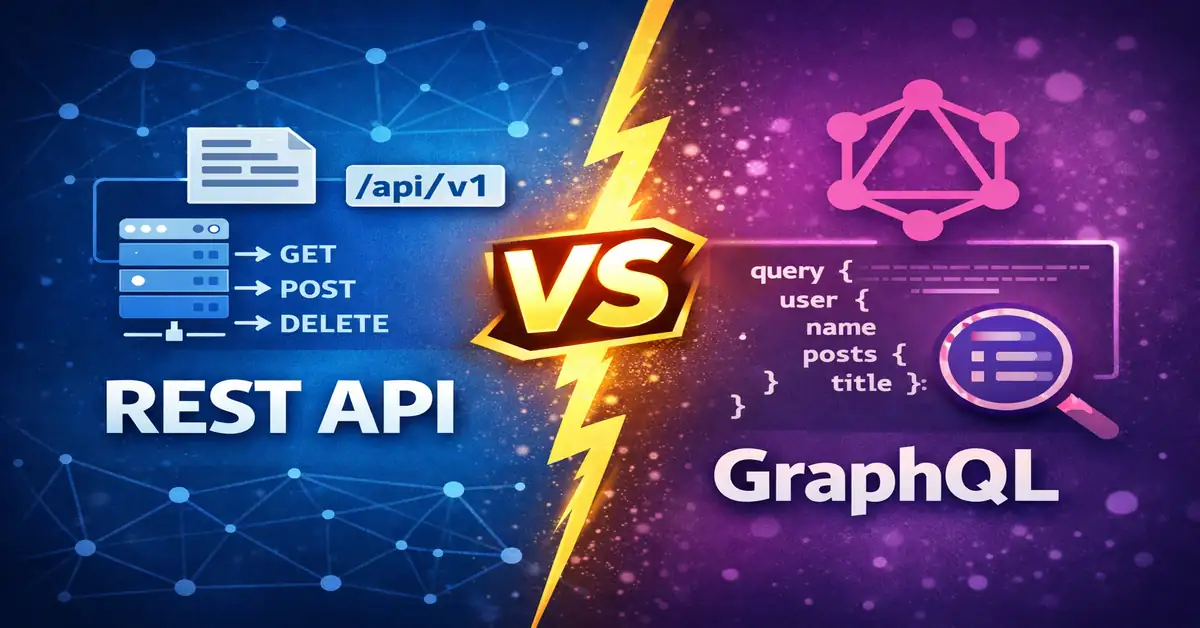
Modern web applications rely on APIs for client-server communication. Two dominant approaches are REST and GraphQL. Both solve similar problems but use different architectural models and trade-offs.
What Is REST?
REST (Representational State Transfer) is an architectural style for designing networked applications. It follows resource-based routing and standard HTTP methods.
Example:
GET /users/1
GET /users/1/posts
POST /users
Key Characteristics
- Resource-based endpoints
- Multiple URLs for related data
- Uses HTTP verbs (GET, POST, PUT, DELETE)
- Stateless communication
Strengths
- Simple and predictable structure
- Strong HTTP caching support
- Mature ecosystem and tooling
- Easy to monitor and rate-limit
Limitations
- Over-fetching or under-fetching data
- Multiple requests for nested resources
- Versioning complexity (v1, v2, etc.)
What Is GraphQL?
GraphQL is a query language and runtime for APIs. It allows clients to request exactly the data they need from a single endpoint.
Typical endpoint:
POST /graphql
Example query:
query {
  user(id: 1) {
    name
    posts {
      title
    }
  }
}
Key Characteristics
- Single endpoint
- Strongly typed schema
- Client-driven queries
- Hierarchical data fetching
Strengths
- No over-fetching
- Fetch nested data in one request
- Self-documenting schema
- Flexible for frontend teams
Limitations
- More complex backend setup
- Caching is harder than REST
- Risk of expensive or deeply nested queries
- Requires query validation and depth limiting
Architecture Comparison
| Feature | REST | GraphQL |
|---|---|---|
| Endpoints | Multiple | Single |
| Data Fetching | Fixed structure | Client-defined |
| Over-fetching | Common | Avoided |
| Versioning | URL-based | Schema evolution |
| Caching | Native HTTP | Custom logic |
| Learning Curve | Low | Moderate |
Performance Differences
REST
Performance depends on:
- Number of HTTP requests
- Payload size
- CDN and browser caching
REST performs well for simple CRUD systems and public APIs.
GraphQL
Performance depends on:
- Query complexity
- Resolver optimization
- Database efficiency
- Proper batching and data loading
GraphQL performs better for complex relational or nested data structures.
When to Use REST
- Public APIs
- Microservices architecture
- Systems requiring strong HTTP caching
- Simple and predictable data models
When to Use GraphQL
- Mobile applications
- Data-heavy dashboards
- Applications with deeply nested relationships
- Multiple client platforms (web, mobile, third-party)
Scalability Considerations
REST Scalability
- Works well with CDN caching
- Easy horizontal scaling
- Clear separation of services
GraphQL Scalability
- Requires query depth limiting
- Needs resolver-level optimization
- Often uses batching and data loaders
- Monitoring query cost is essential
Security Comparison
REST:
- Relies on HTTP standards
- Straightforward rate limiting
- Easier endpoint-level access control
GraphQL:
- Requires query complexity analysis
- Needs depth and cost validation
- Must secure schema exposure
Final Verdict
REST is stable, predictable, and easier to scale with caching. GraphQL is flexible, efficient for complex data, and optimized for modern frontend requirements.
Choose REST for simplicity and public APIs. Choose GraphQL for dynamic, data-rich applications.