Maya was thirty-one, a public school teacher in Sacramento, when she gave birth to her first daughter on a Thursday in March. She had read the books. She had set up the nursery. She had a doula at the birth and a birth plan that survived in some form. What she had not been ready for was the apartment at 11pm on day six, sitting on the bathroom floor in a postpartum mesh underwear, crying because she could not figure out how to fasten her own nursing bra and her husband was already snoring after his first three-hour stretch of sleep in the next room. Her mother was in Phoenix. Her sister was in graduate school in Boston. She felt like she was supposed to be glowing and instead she was pulverised. The pediatrician’s office called the next day for the two-week check, and the nurse asked, almost as an afterthought, how Maya was doing. Maya said fine. Three days later she called back and said actually no. The nurse referred her to a postpartum-specialised therapist, and that was the beginning of the version of postpartum self care that actually worked, which had little to do with the warm-bath imagery on Instagram.

The fourth trimester reality
The fourth trimester is the term obstetricians and pediatricians now use for the first 12 weeks after birth, and it has earned its place. It is not a metaphor. The body is undergoing one of the most rapid hormonal, structural, and metabolic transitions a human body can undergo, while sleep deprived, often healing from major surgical or vaginal trauma, and feeding a newborn every two to three hours. Realistic postpartum self care begins by accepting that this is not a normal time. The same standards of self-management that apply at other life stages do not fit. The body is recovering. The mind is recalibrating. The expectation that a competent adult should be able to manage this without significant external support is a cultural fiction.
What the fourth trimester needs, repeatedly: sleep blocks, food someone else made, fewer tasks not more, and at least one adult human checking in honestly each day. Almost everything else can wait.
Sleep triage strategies that actually work
The standard advice to “sleep when the baby sleeps” is, for most parents, useless. Babies sleep in 30 to 90 minute cycles in the early weeks. Adult sleep architecture needs longer blocks to reach restorative deep and REM stages. The realistic approach is sleep triage, which means structuring blocks of protected sleep with one parent fully off-duty.
The most common version is shift sleep. The non-feeding parent (or the partner if the birth parent is not breastfeeding exclusively) takes a 4-to-6 hour block from roughly 9pm to 2am. The other parent takes the second block from 2am to 7am. With breastfeeding parents, pumped milk allows the partner to do at least one bottle feed during their shift. Even one consolidated 4-hour block per night reduces the worst of the cognitive and emotional symptoms of severe sleep deprivation. Solo parents need to recruit a relative, friend, or postpartum doula for at least one or two blocks per week.
Naps when baby naps remains a real option for some, particularly during the day if a partner can manage household tasks. The honest version is that many birth parents cannot fall asleep on demand in 45-minute windows, and forcing it produces frustration. Even lying down in a dark room without screens for 30 minutes counts as restorative.
Warning signs that require help, not more rest
The “baby blues” describe the mild mood lability common in the first two weeks after birth, driven largely by hormonal shifts. Baby blues resolve. Postpartum mood and anxiety disorders (PMADs) do not. The distinction matters because the treatment paths are different. Universal screening at the 6-week postpartum visit using the Edinburgh Postnatal Depression Scale (EPDS) is the standard of care, and a second screen at 6 months is recommended because PMADs can emerge later. The signs that warrant a call to a clinician within 24 hours:
- Persistent sadness or flat affect for more than two weeks
- Severe anxiety, panic attacks, or intrusive thoughts about harm to the baby
- Thoughts of harming yourself or wishing you had not had the baby
- Inability to sleep even when the baby is sleeping and someone else is on duty
- Inability to eat, sustained loss of appetite
- Racing thoughts, grandiosity, or hallucinations (require immediate emergency evaluation)
The last bullet describes signs of postpartum psychosis, a medical emergency. Our piece on postpartum psychosis covers the urgent recognition and treatment pathway. For non-emergent PMAD treatment, our overview of finding a postpartum-specialised therapist walks through the directory options. Postpartum Support International maintains a national helpline and provider directory at postpartum.net.
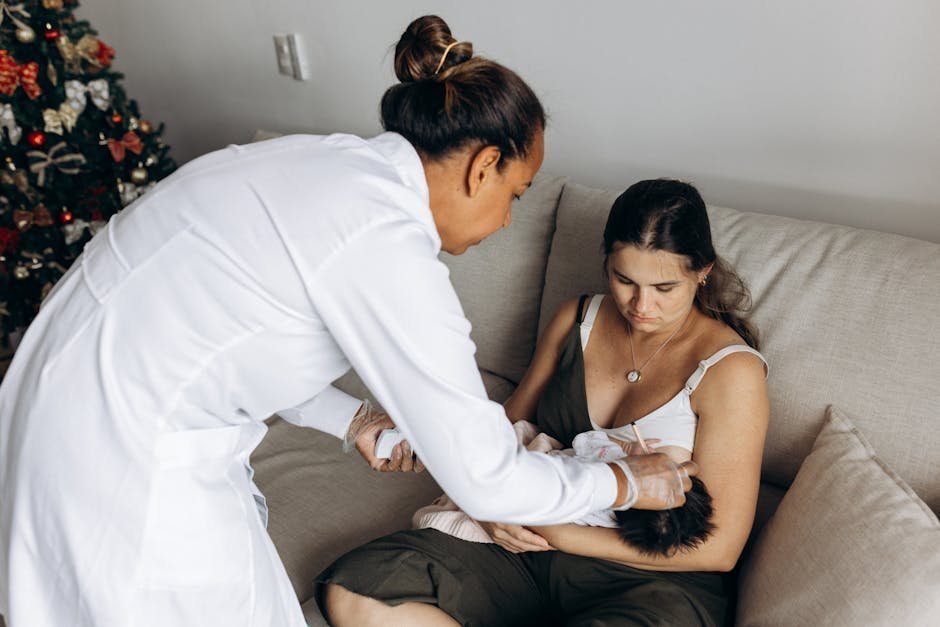
The hormonal trajectory and why it matters
At delivery, estrogen and progesterone drop more rapidly than at any other physiological transition in a person’s life. Within 72 hours, levels approach what they were before puberty. Prolactin rises, sustained by nursing. Oxytocin pulses with feeding and bonding. The thyroid sometimes destabilises, with postpartum thyroiditis affecting up to 10 percent of birth parents and often missed because its symptoms (fatigue, mood changes, hair loss) are attributed to normal postpartum recovery. Iron stores can be depleted from blood loss, and ferritin is worth checking at 6 to 8 weeks even when CBC looks normal.
The hormonal trajectory is not something self-care can fix. It is something to know about so that medical follow-up actually happens. Many birth parents skip the 6-week OB visit or treat it as a formality. It is not. Bloodwork at that visit, including a thyroid panel and ferritin, catches deficiencies that drive months of fatigue and low mood when treated early.
Pelvic floor PT: the underused intervention
Pelvic floor physical therapy is standard postpartum care in much of Europe and remains underused in the US, partly because insurance often does not cover it without specific symptoms documented. The case for routine evaluation, even with insurance friction, is strong. Pelvic floor dysfunction after birth contributes to urinary incontinence, painful sex, prolapse, and lower back pain that can persist for years if unaddressed. Six to ten sessions with a pelvic floor PT in the first six months produces durable improvement in most cases.
The Section on Pelvic Health of the American Physical Therapy Association maintains a directory. Out-of-pocket cost without insurance ranges from $150 to $300 per session in most metros. FSA and HSA funds typically cover it. The womenshealth.gov resource at womenshealth.gov publishes general postpartum recovery guidance including pelvic floor information.
Postpartum doulas and financial accessibility
A postpartum doula is not a baby nurse. The role is different. Postpartum doulas come into the home for shifts (typically 4 to 12 hours, day or overnight) and provide newborn care, light household support, breastfeeding help, and emotional support for the parents. The presence of a non-judgemental experienced person in the home during the early weeks is, for many families, the difference between coping and not coping.
Cost is a real barrier. Postpartum doula rates range from $25 to $60 per hour in most US metros, with overnight rates higher. Some doulas offer sliding scale or short package options. Several states (Oregon, Minnesota, New Jersey, New York) have begun Medicaid coverage of doula services, and the federal Build Back Better legislative push expanded interest. DONA International and the Postpartum Doula Association maintain certifications and directories. For families without budget for paid help, structured friend and family rotations can fill some of the role: one trusted person, one block per week, doing whatever the parent asks for that day, with no opinions offered.
The village rebuild challenge
American postpartum care is structurally hard because the cultural village it relies on does not exist for most families. Extended family lives in another state. Friends are working full-time. Maternal leave is short. Paternal leave is shorter. The traditional postpartum confinement practices found in Mexican, Chinese, Korean, and many other cultures, in which the birth parent is fed, supported, and not expected to do household work for 30 to 40 days, are not built into US life. Building a substitute village is part of the work, and it should start before delivery if possible.
Practical pre-birth planning includes a meal train (Meal Train and TakeThemAMeal both run free coordination platforms), a list of three friends willing to do specific tasks (laundry, grocery runs, baby holding while you nap), and an honest conversation with extended family about what visits will look like, ideally with rules. House guests should arrive ready to help, not be entertained. The first six weeks are not the time for hosting.

Partner mental health: the often-missed piece
Paternal postpartum depression is real and affects roughly 10 percent of fathers in the first postpartum year, with rates higher when the birthing parent also has a PMAD. Non-birthing partners in same-sex partnerships have similar rates. Symptoms often present differently: irritability rather than sadness, social withdrawal, increased alcohol use, working late as avoidance, and a sense of disconnection from the baby. Few systems screen partners. The result is that partner depression often goes undetected until the relationship is in real trouble.
Postpartum Support International runs partner-specific helplines and groups. Talking to a regular therapist, ideally one with perinatal training, is appropriate even if symptoms feel mild. Couples therapy in the first postpartum year, even briefly, helps many couples navigate the transition without it becoming a deeper rupture. Our overview of lifestyle-based mental health interventions covers some of the layered approaches that suit partners with mild symptoms.
Returning to your body, slowly
The body recovery curve is non-linear. Six weeks postpartum is the conventional clearance for most activity, but clearance is not readiness. Walking, gentle stretching, and rebuilding core stability with a postpartum-trained PT or trainer should precede return to running, lifting, or high-impact exercise. Many parents return to pre-pregnancy activity too fast, develop pelvic floor or back symptoms, and then take longer to recover than if they had ramped slower. Diastasis recti, the separation of abdominal muscles common after pregnancy, often requires specific rehab work and benefits from professional assessment rather than generic core exercises.
What helps in the first three months: walking outside daily, hydration that matches feeding demands (extra 16 to 32 ounces per day if nursing), eating regularly (three meals plus snacks rather than skipping), and avoiding the pressure to lose weight quickly. Bodies recover better when they are fed.
Frequently asked questions
How long does the fourth trimester really last?
The intensive 12-week marker is the conventional end, but most parents report a continued recovery period through six months and a settling phase through the first year. Treat the first year as recovery, not just the first 12 weeks.
Is feeling overwhelmed normal or a sign of PMAD?
Some overwhelm is normal. Sustained inability to function, persistent dread, or thoughts of harm are not normal and warrant a clinical screening. The EPDS is a free, validated tool you can complete online or with your provider.
Can I take SSRIs while breastfeeding?
Several SSRIs are well-studied in breastfeeding and considered compatible. Sertraline is often first-line. Decisions should be made with a perinatal psychiatrist or an OB familiar with the literature. Untreated PMAD has its own risks for both parent and infant.
How do I find a postpartum doula on a budget?
Look for newly certified doulas building hours at lower rates, doula collectives with sliding scale, hospital postpartum programs in some metros, and state Medicaid coverage if eligible. Even a few hours per week makes a difference.
What if my partner does not believe my depression is real?
Bring them to a clinical appointment if possible. The OB, midwife, or therapist explaining PMAD as a medical condition is often more effective than the patient explaining it. Postpartum Support International also offers partner-focused educational resources.
The bottom line
Postpartum self-care in the first year is not bubble baths and yoga pants. It is sleep triage, food someone else cooked, screening for PMAD, treating hormonal and physical recovery as actual medicine, building a substitute village, and protecting partner mental health. The first year is recovery. Treat it that way and the second year is meaningfully easier.
If you are in immediate emotional crisis or thinking about suicide, call or text 988 to reach the Suicide and Crisis Lifeline. Trained counsellors are available 24/7 and the call is free and confidential.
This article is for educational purposes only and does not constitute medical or psychological advice. Always consult a licensed obstetrician, pediatrician, or mental health professional for diagnosis and treatment of perinatal conditions.